
The Fruitful Darkness
- Ruben Carpentier Wild Hearts
- Feb 19
- 3 min read

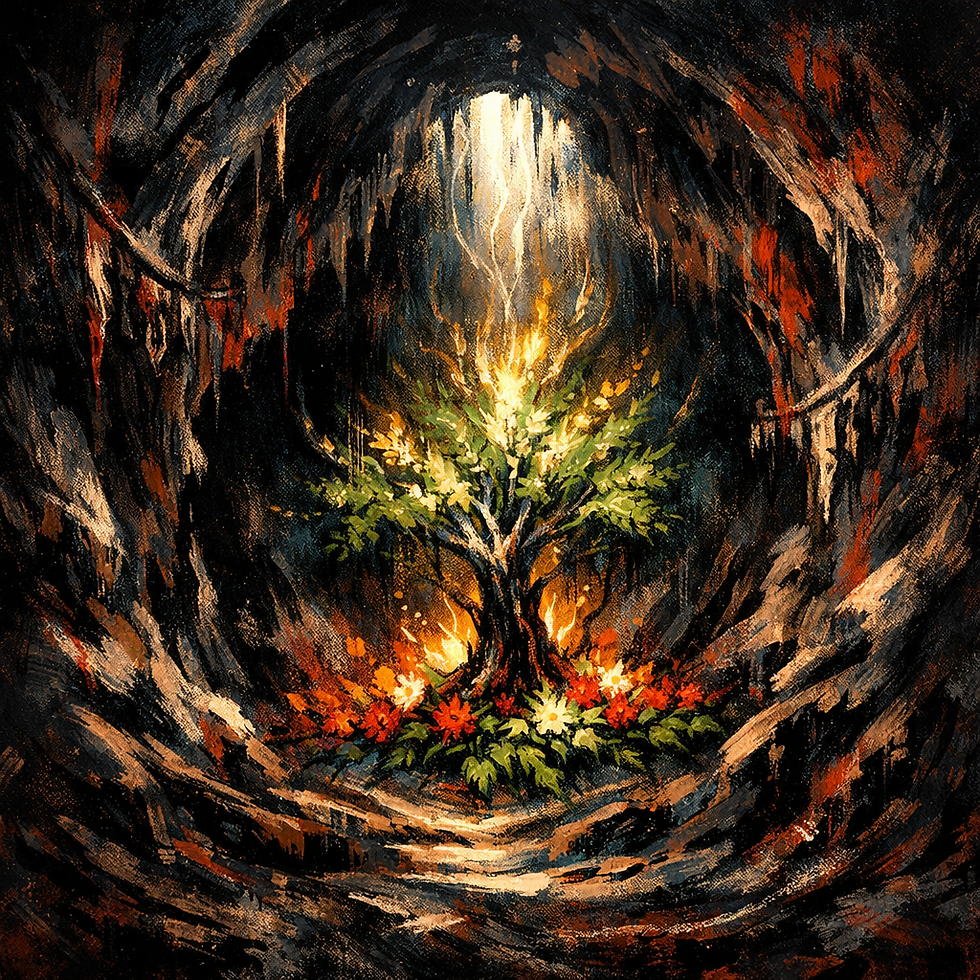
I’ve been listening to the song "The Fruitful Darkness" by Trevor Hall for weeks now.
Not casually. Not in the background.
But the kind of listening where a song starts listening back to you.
There’s a line that keeps undoing me:
“In the dark of my dark, that’s where I found my light.”
At some point, it became clear that I wasn’t just listening to a song anymore.
I was circling something ancient.
Something I didn’t have language for yet.
So I decided to write my own version — not as a response to the song, but as a confession to life.
Because what I’m discovering is this:
Some of us are not meant to live on the surface of things.
And the price of that is darkness.
---
For as long as I can remember, life has felt magical to me.
Not magical in a naive or escapist way.
Magical in a visceral, cellular way.
The kind of magic you feel when mountains suddenly feel like elders.
When a forest doesn’t feel quiet but listening.
When love — real love — feels bigger than romance, bigger than people, bigger than stories.
This sensitivity has always been there.
And for most of my life, I tried to manage it.
I tried to soften it.
Tone it down.
Explain it away.
Anchor it in relationships.
Turn it into something safe, predictable, controllable.
Simply said, I felt it but was unable to fille believe it existed.
But sensitivity doesn’t work like that.
Sensitivity is a doorway — not a trait.
And when you open that doorway wide enough to let the light of the world in,
you also open it wide enough for the darkness to enter.
---
Here’s the part we don’t talk about enough:
The same nervous system that can feel life as deeply sacred
can also feel loss as annihilating.
The same heart that perceives beauty everywhere
will feel emptiness more sharply.
This isn’t pathology.
It’s not weakness.
It’s not something to fix.
It’s the cost of living life deeply.
And yet, we live in a world that treats darkness like a mistake.
We pathologize it.
We rush to label it.
We medicate it.
We coach it away.
We try to “get back to the light” as fast as possible.
But what if the darkness isn’t the absence of light?
What if it’s the soil?
---
There is a kind of darkness that doesn’t want to be solved.
It wants to be entered.
It doesn’t come with answers.
It comes with humility.
It strips you of narratives.
It dissolves identities.
It makes future-thinking feel impossible.
Not because life is over —
but because something old is dying.
And death, when it’s real, is never joyful.
The fruitful darkness isn’t dramatic.
It’s quiet.
Heavy.
Slow.
It’s the place where you stop pretending you know who you are.
And paradoxically, it’s also the place where life feels most honest.
---
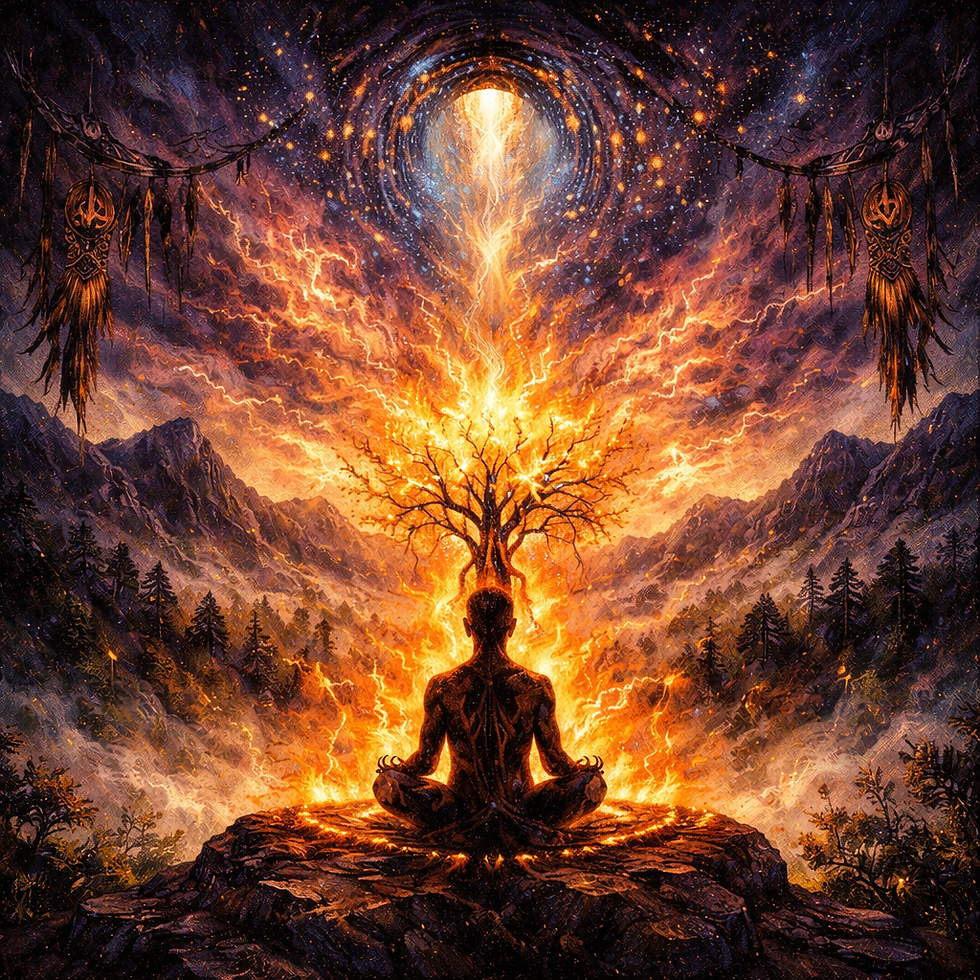
What I’m learning is that magic doesn’t disappear in the darkness.
It deepens.
It becomes less flashy.
Less romantic.
Less performative.
More rooted.
More embodied.
More real.
The magic shifts from “look at how beautiful life is”
to “look at how much life can be held.”
Held without bypass.
Held without optimism.
Held without needing it to make sense yet.
This kind of magic doesn’t sparkle.
It hums.
---
There’s something profoundly humbling about realizing this:
That darkness is not a failure of consciousness.
It’s a phase of it.
That sensitivity is not meant to make life easier —
it’s meant to make life truer.
That some people are not here to be consistently happy,
but to be consistently alive.
Alive enough to feel the full spectrum.
Alive enough to live profoundly.
Alive enough to let emptiness do its work.
Alive enough to trust that something is growing,
even when nothing is visible.
---
I don’t write this as a conclusion.
Or a teaching.
Or a resolution.
I write it as a recognition.
That the darkness I’m walking through is not opposed to the magic I love.
It’s part of the same movement of life.
And if I stay —
if I don’t rush —
if I don’t turn away —
Then something honest can bloom.
Not because I forced it.
But because I finally stopped resisting the night that knows how to grow things.
Written by Ruben, cleaned up with AI (in all honesty)


Comments